Composition
Rule of thirds vs. golden triangle: when each wins
Two grids, two different jobs. The rule of thirds composes for stability; the golden triangle composes for tension. Here's how to pick the right one in the moment.
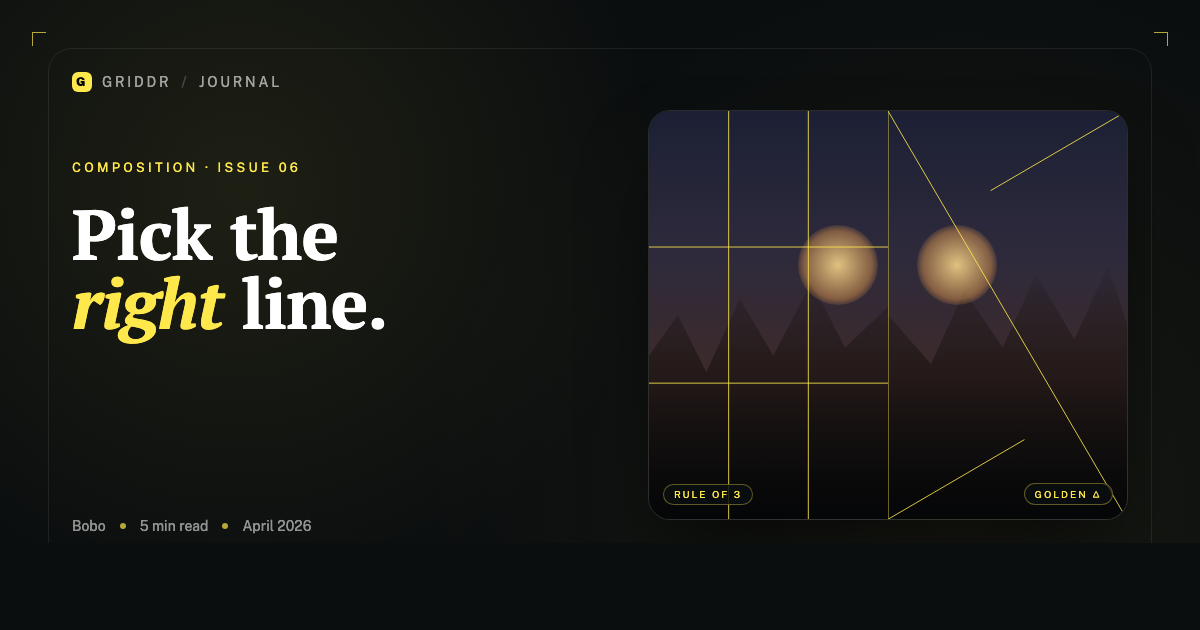
The fastest way to feel the difference between these two grids is to point your camera out a window and switch between them. You're looking at the same view. The rule-of-thirds version feels balanced and quiet. The golden-triangle version feels like something is about to happen.
That's not an accident, and it's not subjective. The two grids are doing different work.
What each one is
Rule of thirds. Two horizontal lines and two vertical lines, dividing the frame into nine equal rectangles. Subjects go on the lines or at the four intersections.
Golden triangle. A diagonal line corner-to-corner, plus two shorter lines from the other two corners that meet the diagonal at right angles. The frame is sliced into four triangular regions. Subjects go on the lines or at the points where the lines meet.
The rule of thirds is orthogonal — its lines run with the frame. The golden triangle is diagonal — its lines cut across.
That's the whole difference, and that's what makes them feel different.
What "stability" and "tension" mean here
I'm not being vague when I say one is stable and one is tense. The eye reads horizontal and vertical lines as stable because they match how we stand and how we read. We see horizons and walls all day. A horizontal third on a horizon and a vertical third on a tree both echo what the world looks like to us. The composition disappears. You're left with the subject.
A diagonal cuts across that. The eye doesn't have a corresponding day-to-day experience of seeing the world on a 30° slope. So when a subject sits on a diagonal line, the line itself becomes part of the photograph — it's doing something. It moves the eye. It implies travel, weight, fall.
That's tension. Sometimes you want it.
Horizontals and verticals disappear. Diagonals stay loud.
Rule of thirds wins for
Landscapes. Horizons are horizontal. Vertical thirds work for trees, lighthouses, columns. The rule of thirds is doing the same job the world is — it stays out of the way.
Single-subject portraits. A person standing or sitting is a vertical figure. Their eyes land on a horizontal third. Their body lands on a vertical third. The grid reinforces the structure of the subject without competing.
Product photography. Same reason. The product is rectangular or cylindrical, vertical or horizontal. The grid matches.
Architecture, flat-on. Buildings have horizontal floors and vertical walls. The grid does too.
Anything with internal symmetry that you don't want to center. A face turned slightly off-axis. A doorway you want to feel inhabited, not staged.
Golden triangle wins for
Diagonal motion. Anything that's leaning, sliding, falling, running. A skateboarder mid-grab. A surfer angled into a wave. A dog running across the frame. The diagonal of the triangle echoes the diagonal of the motion.
Diagonal lines that are part of the scene. A cobblestone street receding. A fence cutting across a field. A staircase. The triangle's diagonal can ride along that real line, and now the composition is reinforcing the lead-in instead of fighting it.
Tension between two subjects. Two people about to argue. A mother watching a kid run away. The triangle's lines connect them across the diagonal — they're related even when they're far apart in the frame.
Photos that need to feel unsettled on purpose. Editorial work. Reportage. Music photography. Anything that wants to feel like it was caught, not posed.
How to actually choose in the moment
Three questions, in order:
- Is the subject vertical or horizontal? If yes — rule of thirds. The grid will be quiet under the photo.
- Is there a diagonal line or motion in the scene? If yes — try the triangle. The grid will reinforce the line.
- Do I want the photo to feel calm or charged? Calm: thirds. Charged: triangle.
These questions are fast. After a few hundred shots you'll stop asking them out loud and just feel the right grid for the scene.
What about diagonal landscapes?
You'll hit the edge case where the scene is a landscape (which says rule of thirds) but the strongest line is diagonal — say, a mountain ridge running corner to corner. In those cases I'll often shoot both versions, with the rule-of-thirds horizon and with the golden triangle diagonal, and pick the one that survives review.
If you only get one shot, default to the rule of thirds for a horizon-dominant scene and the triangle for a ridge-dominant one. The line that does the most visual work should sit on the more matched grid.
A small Pro-tier note
The golden triangle is one of Griddr's Pro grids. There's a reason it's not in the free tier: most casual shooters won't reach for it, and offering it free crowds the grid menu for people who'd never use it. If you find yourself wanting it often — if you shoot motion, sports, street, or anything that needs charge — Pro pays for itself the first weekend you use it.
These two grids are tools, not preferences. Pick the one that does the job. Most of the time that's rule of thirds, and that's fine — but the day you need a diagonal and you don't have one, the photo notices.
Related reading
Shoot this with Griddr
Get Griddr — free on iOS & Android