Composition
Rule of thirds: 12 real examples from your phone
Most rule-of-thirds tutorials never tell you which intersection point to use. Here are 12 specific situations and the exact line to put your subject on.
The rule of thirds is the most-taught and least-explained idea in photography. Every tutorial draws the same nine-box grid, says "put your subject on a line or an intersection," and stops there. Useful as far as it goes — which is not far at all when you're standing in a parking lot trying to photograph your kid's bike.
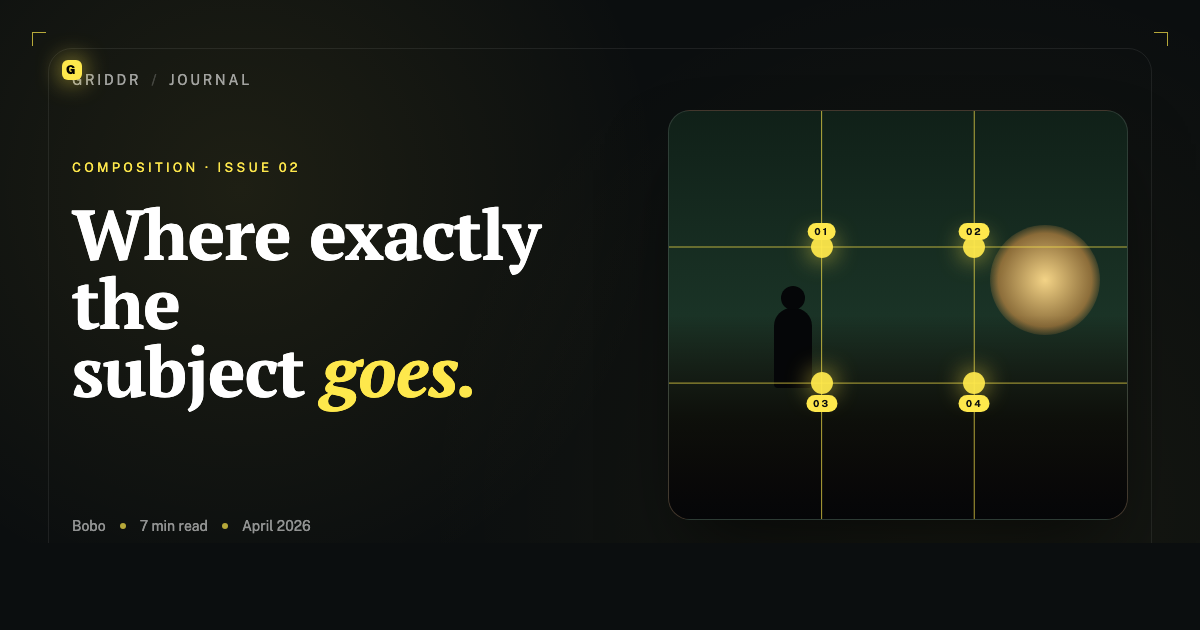
The four intersections aren't equivalent. They each do something different, and once you see what, you'll stop putting subjects on the wrong one.
Here are 12 situations I run into in a normal week with a phone, and where I aim.
Anchors: top-right and bottom-left
These two intersections feel like they're holding the frame. Western viewers read left-to-right and top-down, so the top-right is where the eye finishes; the bottom-left is where it starts. A subject on either of these intersections feels settled.
1. A coffee cup on a café table. Top-right intersection, with the rest of the table receding to the bottom-left. The cup gets the visual weight; the empty table tells the story.
2. The kid running away from camera. Bottom-left, looking out toward the top-right. You're putting the subject "behind" the eye's path — they have somewhere to go.
3. A solo flower in a wide landscape. Bottom-left if the sky is doing the work; top-right if the foreground is.
Tension: top-left and bottom-right
These two are the opposite. They put the subject against the eye's natural travel. The result feels off-balance — sometimes that's bad, sometimes it's exactly the point.
4. A face turning to look back over a shoulder. Top-left, facing right. The viewer's eye lands on the face and then chases the gaze across the frame. That tension is the photo.
5. A storm cloud rolling in. Top-left, with the rest of the sky open. You're staging the next moment.
6. A subject who is uncomfortable in the frame. Bottom-right is where unease lives. Use sparingly.
The lines, not the points
The rule of thirds isn't only four dots. The lines themselves matter, and most of the time you'll use those, not the intersections.
7. A horizon. On the upper third line if the foreground matters; on the lower third if the sky matters. Almost never on the middle. (See Level every horizon for the why.)
8. A standing person, full body. Their spine on a vertical third. Their eyes near a horizontal third — usually the upper one if it's a portrait, the lower one if it's environmental.
9. A doorway in a hallway shot. Vertical third, almost always. Centering it makes the photo feel like a real-estate listing.
10. A bird on a wire. The wire on a horizontal third, the bird on a vertical third. You get two thirds for the price of one.
The rule of thirds isn't four dots. It's two lines and two more lines, and most of the time you'll use the lines.
When to ignore it
Rule of thirds is a default, not a law. It loses to two other patterns often enough that you should know them.
11. Symmetry. A reflection on still water, a face straight on, a hallway that vanishes to a single point. Center it. The whole point of the photo is the symmetry; thirds will fight you.
12. Dead center, hard. Sometimes you want to make a viewer uncomfortable. Centering a face with no breathing room around it is a confrontation. That's a real composition tool — just deliberate, not lazy.
What I actually do
Open the camera, pull up the rule-of-thirds overlay, and ask one question before pressing the shutter: which third is doing the work in this photo? If the answer is "I don't know," I usually don't have a photo yet. I move three feet left or right and ask again.
If the subject doesn't land on any line — and the photo isn't symmetrical — that's the photograph's tell. There's no anchor. The viewer's eye will drift around looking for one and bounce off.
The rule of thirds is your first grid because it's the one that fixes the most common mistake: dead-center subjects in non-symmetrical photos. After a few hundred shots with it, you'll start noticing the cases it doesn't fit. That's when you reach for a different grid, or build your own.
Related reading
Shoot this with Griddr
Get Griddr — free on iOS & Android